Intraosseous PRP & BMAC Injections for Knee Arthritis
A Precision-Guided Approach to Treating Knee Arthritis
For many years, knee osteoarthritis was thought to be primarily a disease of worn cartilage. Today, research has shown that osteoarthritis affects the entire joint, including the cartilage, synovium, ligaments, meniscus, and the subchondral bone beneath the cartilage.
Growing evidence suggests that changes within the subchondral bone may play an important role in pain and osteoarthritis progression. This has led to growing interest in intraosseous orthobiologic injections, an advanced technique designed to deliver treatment directly into the bone beneath areas of damaged cartilage.
At IOSD, intraosseous procedures are performed using precision fluoroscopic guidance to accurately target areas of subchondral bone pathology while prioritizing procedural safety and precise treatment delivery.
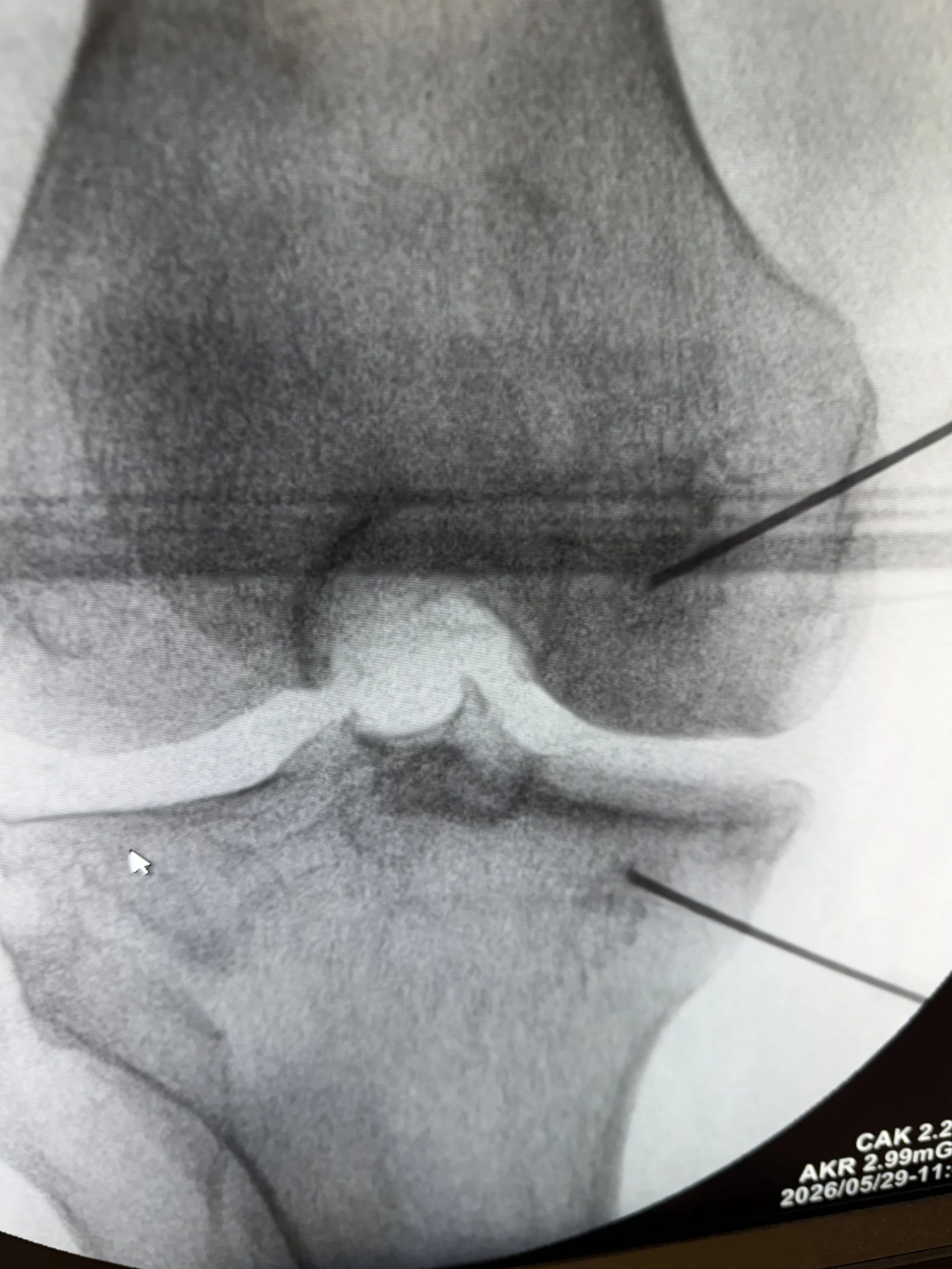
Why Treat the Bone?
Traditional knee injections—including corticosteroids, hyaluronic acid, and many PRP injections—are typically delivered into the knee joint.
However, osteoarthritis is not confined to the joint space alone. The subchondral bone beneath the cartilage can undergo structural and biologic changes that are associated with pain and progression of osteoarthritis.
For appropriately selected patients, treating both the joint and the underlying subchondral bone may provide a more comprehensive approach by addressing multiple components of the arthritic joint.
What Does the Research Show?
Growing evidence supports the use of intraosseous orthobiologic injections for appropriately selected patients with knee osteoarthritis.
Research by Dr. Philippe Hernigou and colleagues has reported encouraging long-term outcomes using Bone Marrow Aspirate Concentrate for knee osteoarthritis, including improvements in pain and function and delayed progression to knee replacement in certain patient populations.
Additional research by Dr. Mikel Sánchez and colleagues has found that combining intra-articular and intraosseous PRP injections may provide greater improvements in pain and function than treating the joint alone. Together, these studies support the understanding that knee osteoarthritis involves the entire joint—not just the cartilage—and that the subchondral bone may be an important treatment target for select patients.
While research continues to evolve, intraosseous orthobiologic treatment represents a promising approach for addressing both the joint and the underlying bone in appropriately selected patients with knee osteoarthritis.
Clinical Evidence
Long-Term Subchondral BMC & Knee Arthroplasty Outcomes
15-year randomized study — Hernigou et al., 2021
Intra-Articular + Intraosseous PRP for Severe Knee Osteoarthritis
Clinical trial — Sánchez et al., 2016
Intraosseous PRP for Knee Osteoarthritis
Systematic review & limited meta-analysis — 2022
Medically reviewed by Melanie Worley, DO | September 2026
Fellowship-trained in Sports Medicine & Interventional Orthobiologics
Why Precision Matters
Successful intraosseous procedures require advanced training and meticulous technique.
Accurately placing treatment into the subchondral bone requires specialized needles, fluoroscopic imaging, and a detailed understanding of knee anatomy. Physician experience is critical to safely and precisely target the intended area of pathology.
At IOSD, every intraosseous procedure is personally performed by Dr. Melanie Worley using advanced image-guided techniques developed through fellowship training in interventional orthobiologics.